John’s Files 06: The Voynich Manuscript
A language is only dead if nothing answers it.
Recovered from USB folder: /TEXT/VOYNICH/GLYPH_RETURN/
Original blog status: vanished
Recovered by: Jean Phil Sorrowfield
File condition: recovered text, corrupted PDF annotations, one missing image
Pattern tag: 0101
Assigned sequence number: 13
Object: Voynich Manuscript
Archivist’s Note
The Voynich file was recovered in unusually good condition, except for one missing image.
The missing image was referenced thirteen times.
John’s draft described it as “the page that looked back.”
No image with that name survived on the USB.
John’s entry begins below.
1. Opening Note
The most frightening books are not the ones that cannot be read.
They are the ones that remain patient.
A locked book is just a door with better posture.
The Voynich Manuscript has kept its posture for centuries.
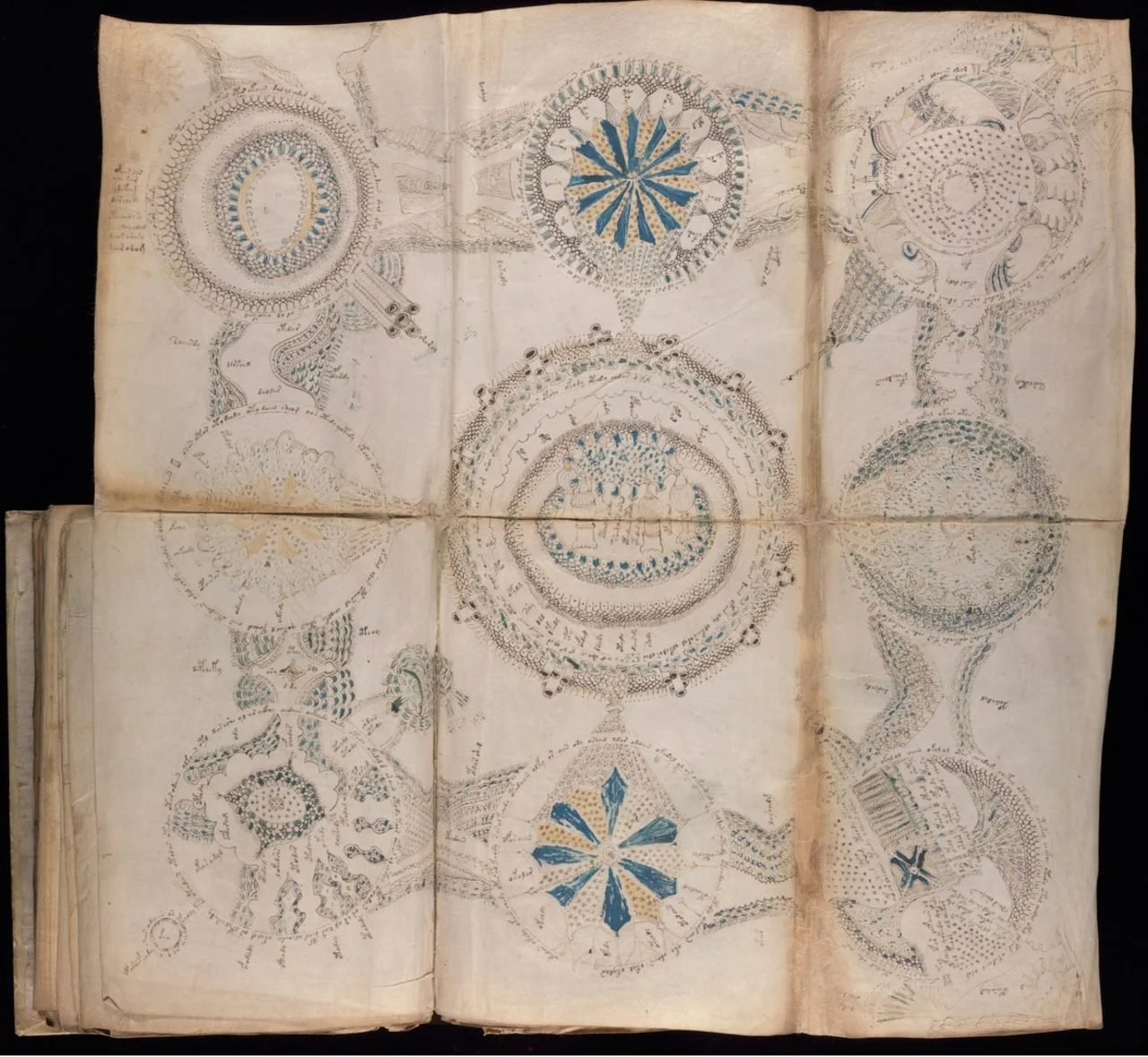
Unknown script. Unknown author. Unknown purpose. Botanical drawings, strange diagrams, women in impossible pools, stars arranged like private weather.
Everyone wants to translate it.
I wanted to know why it had survived being misunderstood.
Those are not the same question.
2. Public Record
The Voynich Manuscript is a medieval codex written in an undeciphered script. It has been studied, argued over, digitized, dismissed, adored, and accused of being language, cipher, hoax, medicine, ritual, astronomy, nonsense, genius.
No consensus has emptied it.
That is part of its power.
A mystery that refuses solution becomes a mirror.
Every reader sees the thing they are most prepared to fear.
I saw a pattern.
Of course I did.
By then, I was infected with looking.
3. The Thirteen References
I was reviewing a digital scan when one folio froze on-screen.
Not crashed. Frozen.
The page remained visible while the rest of the interface stopped responding.
The illustration showed plant forms. Roots, stems, leaves. Or what a plant might draw if it had only heard humans describe botany through a wall.
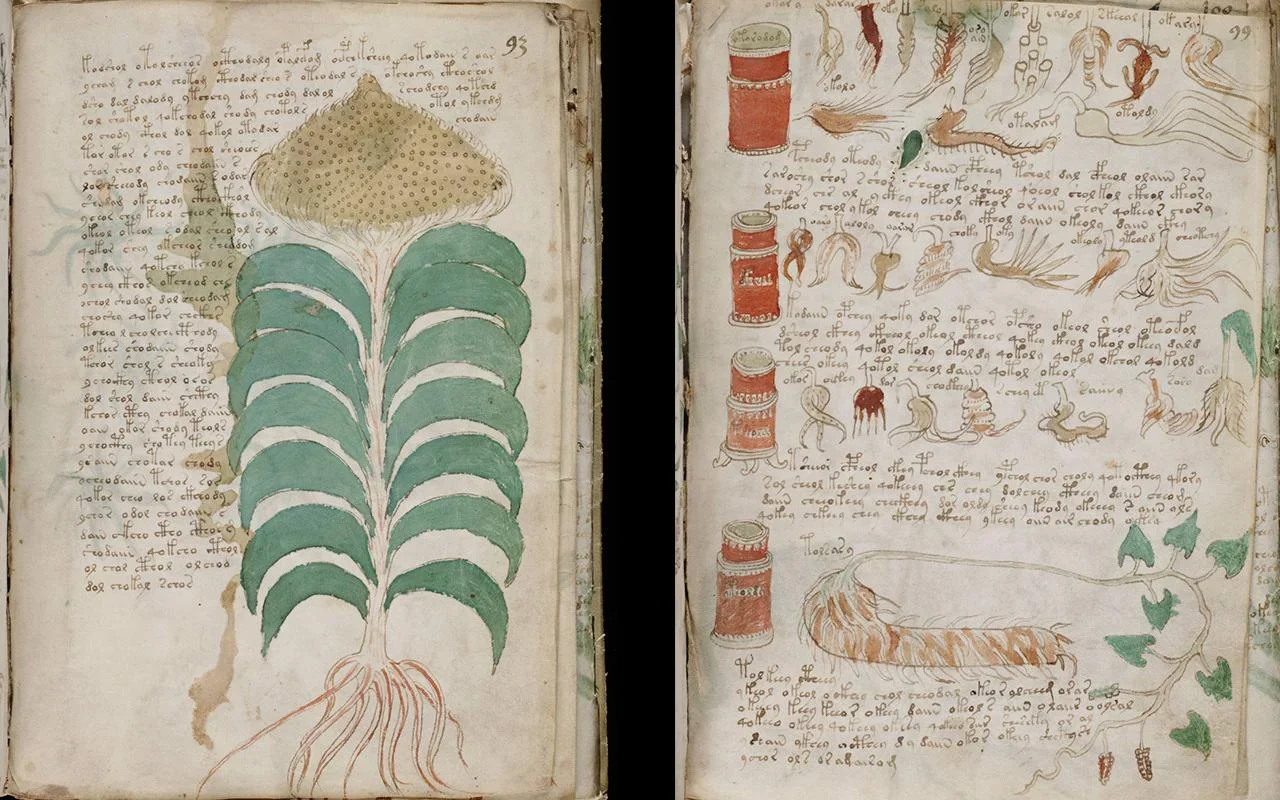
I noticed a repeating leaf structure.
Small. Large. Small. Large.
0.
1.
0.
I searched my notes for similar forms.
The same shape appeared in thirteen places.
Not twelve. Not fourteen.
Thirteen.
I marked them and the PDF closed by itself.
When I reopened it, the annotations were gone.
The export folder contained thirteen empty PNG files.
Each one named:
lilly_leaf_01.png
lilly_leaf_02.png
lilly_leaf_03.png
I had not named them.
4. The Missing Image
The missing image should have been file 08.
The sequence skipped it.
lilly_leaf_07.png
lilly_leaf_09.png
No 08.
I searched the USB.
There was one damaged thumbnail in a temp folder.
The preview showed a page margin from the manuscript. In the blank edge, something had been drawn in a different hand.
A doorway.
No.
Not a doorway.
A rectangle of darkness pretending to be architecture.
Below it were four marks:
0 1 0 1
Then the image failed.
5. Personal Log
I dreamed of Lilly sitting at the kitchen table with a book too large for her lap.
She was tracing symbols with one finger.
I told her not to touch it.
She looked up and said:
But it knows my name in another order.
When I woke, there were thirteen search tabs open on my laptop.
All blank.
The browser history showed no URLs.
Only titles:
word_before_grief
root_after_child
water_without_body
do_not_translate_the_opening
The thirteenth tab title was:
3282025
I closed the laptop and heard paper turning somewhere in the apartment.
I own no paper that heavy.
6. Working Hypothesis
The Voynich Manuscript does not need to be supernatural to be dangerous to me.
Its danger is structural.
It proves that a text can generate centuries of attention without surrendering itself.
That is an energy source.
Attention without resolution.
Study without closure.
Language without access.
The pattern likes unsolved systems.
They are open circuits.
If enough people lean over the same silence for long enough, something may eventually lean back.
Maybe not from the manuscript.
Maybe through it.
7. Pattern Notes
Repeated leaf clusters: 13
Missing image: 08
Visible sequence: 0101
Recovered tab title: 3282025
Associated files: Brazil, Taos, Whittier
A corrupted annotation recovered from the PDF reads:
The book is not unread. It is waiting for the correct grief.
I hate that sentence.
I hate that I understand it.
8. Closing Entry
Do not mistake an unreadable text for a silent one.
A locked language still has weight.
It can sit in a room for centuries and change the temperature of everyone who tries to open it.
I keep thinking about Lilly’s dream sentence:
It knows my name in another order.
Maybe that is all a spell is.
A name placed where grief can find it.
John
Archivist’s Closing Note
This file later becomes important because John begins treating language as a carrier, not just sound or signal. His blog entries after this point show more typographic corruption.
Some letters reverse. Some words repeat. Lilly’s name appears in filenames John claims he did not create.
— Jean Phil Sorrowfield
